

Consumer Unsecured Debt-to-Income Ratio at Record Low
- UK households owe more than ever, but unsecured debt burdens relative to income remain at historic lows
- Credit industry growth is increasingly generated by existing borrowers taking additional products, rather than new consumers entering the credit market
- Credit participation remains comparatively low, leaving headroom for responsible market growth
Research by TransUnion shows that UK households owe more than ever on their credit repayment obligations, with outstanding unsecured debt balances continuing to grow at a high rate. However, the significant growth in median income has broadly kept pace with, and at times outpaced, growth in debt per borrower, with debt relative to income sitting at the lowest level since 2019.
Overall, the growth in consumer indebtedness appears to have been manageable. However, signs of pressure are emerging in parts of the credit market, with rising consumer delinquency rates observed across credit cards and unsecured loans. While consumer delinquency rates are the highest since Q2 2021, they are still significantly below pre-pandemic levels.
These are among the findings of TransUnion’s Q2 2026 UK Credit Industry Insights Report, which also showed that both credit cards and unsecured loans saw significant growth in outstanding balances, with credit card debt up 9.1% year-over-year (YoY), and unsecured loan balances up 7.9% YoY, both significantly outpacing the Q2 20261 annual price inflation rate of 2.8%.
This expansion was likely driven by a combination of strong consumer income growth and increased lender willingness to advance credit. The greater lender risk appetite is partly driven by a significant increase in competition for market share and partly reflects a return to the normal state of play observed in the periods pre-pandemic and pre-inflation shock. While the headline growth for credit cards and loans appears significant, it’s crucial to note that debt per borrower increased at a marginally slower rate than median income. Median income rose 4.91% YoY over this period, while credit card debt per borrower grew by 4.58% YoY and unsecured loan debt per borrower grew by 4.13% YoY.
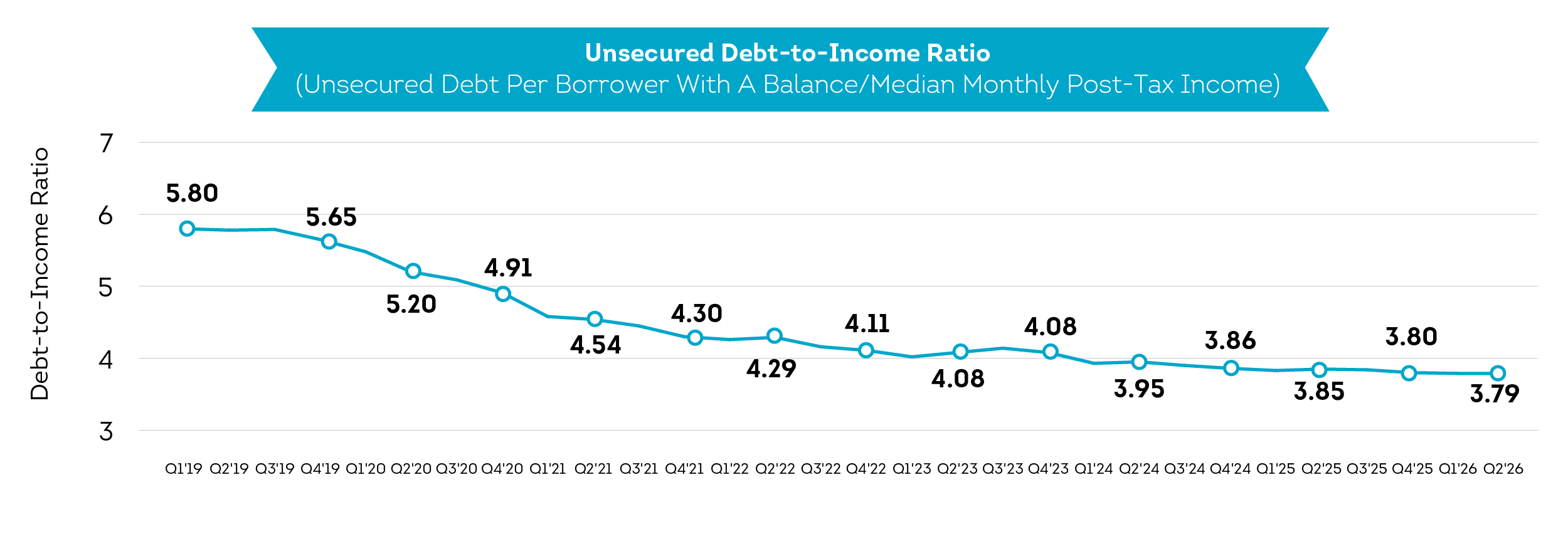
Headline debt growth can raise concerns about over-leveraging, but it does not necessarily mean that household finances are weakening. Whether higher borrowing is sustainable depends not only on how much debt consumers hold, but also on how their incomes are growing to support capacity to borrow and repay. In fact, thanks to the strong growth in incomes, the debt-to-income ratio dropped to 3.79 in Q2 2026, down from 3.85 in Q2 2025.2
The longer-term view is even more striking, with the debt-to-income ratio now lower than the 5.78 of Q2 2019, before the pandemic, and 4.26 in Q1 2022, before the inflation shock was first felt. This shows that UK consumers are carrying more unsecured debt in absolute terms, but that debt is a much smaller share of their income than it was before either of the recent economic shocks. It’s equally worth noting that the secured debt-to-income ratio is down 15% from the start of the 2022 rate hikes, due to both high income growth, and the higher cost of secured credit.
Chart 1: Unsecured Debt to Income Ratio3
Some increase in serious delinquency in Q2 2026 has nevertheless accompanied the expansion of unsecured credit. The proportion of credit-active consumers with at least one account 90 or more days past due rose by 30 basis points (bps) YoY to 3.50%. That movement warrants monitoring but remains well below the 4.30% to 4.60% range recorded in 2019 and appears contained even as credit card and unsecured loan balances have grown over the last few years. The market is no longer experiencing the exceptionally low delinquency conditions that followed the pandemic, but neither has it returned to pre-pandemic levels of serious arrears.
The deterioration was led by unsecured loans, where the consumer delinquency rate increased by 68 bps to 4.39%. Credit cards recorded a smaller 19 bps increase to 2.18%, while mortgage and motor finance delinquency rates declined. This indicates that financial stress is not rising universally, but rather is becoming visible in unsecured products where lending has expanded most strongly.
This should be considered in the context of lenders actively broadening the range of borrower risk they are willing to accept in their new accounts opened. Average credit scores of borrowers for newly opened accounts dropped 32 points for credit cards and 28 points for unsecured loans from the peak level of conservative lending seen in Q2 2023 to the latest view of Q2 2026. The credit card score thresholds are now closer to par with normal levels seen in 2019, however the unsecured loan score thresholds have dropped significantly from 2019 levels. Lower origination scores demonstrate that lenders are increasingly willing to extend credit to consumers with higher expected credit risk. The emerging rise in delinquency does not mean that consumers are experiencing greater financial stress, but rather a shift in the industry credit portfolio to more borrowers with higher default risk, which warrants closer monitoring.
“The increase in consumer unsecured delinquency rates should not be overlooked, particularly within unsecured loans, where the movement has become more pronounced,” said James O’Donnell, director of research and consulting at TransUnion in the UK. “However, overall consumer delinquency rates are still sitting well below pre-pandemic norms, debt remains historically low relative to income and performance has improved across mortgages and motor finance. The evidence points to segments of emerging pressure among an otherwise stable and resilient consumer base.”
Credit Industry Growth Driven by Existing Borrowers Holding More Accounts
Despite the strong growth observed in unsecured consumer credit balances and number of accounts opened over the last few years, the proportion of adults engaging with credit has remained relatively flat. Growth in credit activity has been increasingly generated by existing borrowers taking additional products, rather than more consumers entering and participating in the credit market.
The proportion of adults holding credit rose to 70.0% in Q2 2026, relatively flat from 69.6% in the same quarter last year. This remains well below the 73.5% of adults that held credit in Q2 2019. This can be further broken down into the 13.0% of adults that hold a credit product with no balance, leaving just 57.0% of the adult population holding an outstanding credit balance, down from 60.0% in Q2 2019.
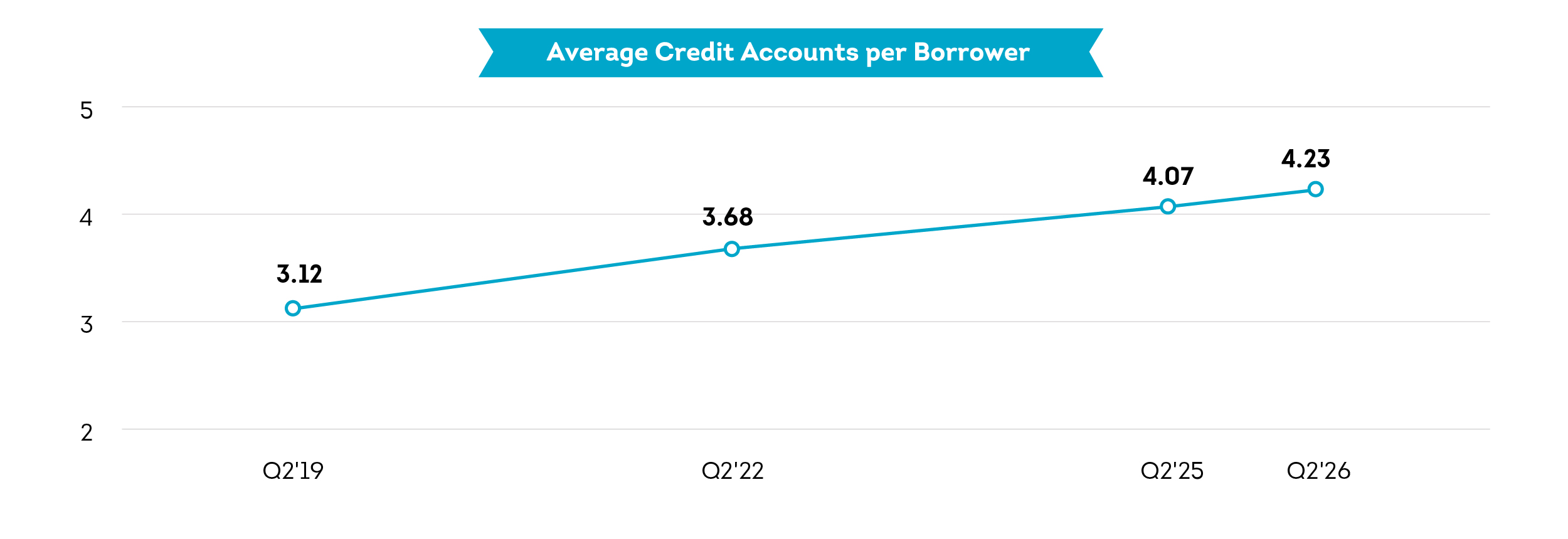
The average borrower now holds materially more open accounts than before either the 2019 pandemic disruption or the 2022 inflation shock. The change indicates a progressively more interconnected credit market, in which growth has come increasingly from consumers holding several concurrent lender relationships, rather than from a comparable expansion in the number of people using credit.
Chart 2: Average Accounts per Borrower3 & 4
“The market is adding credit relationships faster than it is adding new credit participants,” concluded O’Donnell. “Participation remains below pre-pandemic levels, so the opportunity is not simply to offer more products to existing borrowers, but to identify new consumers for whom responsible access to credit could create lifetime value.”
Notes:
1 CPIH ANNUAL RATE - June YoY - Office for National Statistics
2 The debt-to-income ratio is calculated as average unsecured debt held by consumers with a balance, divided by median monthly take-home pay after tax
3 TransUnion U.K. consumer credit data analysis
4 Average accounts per borrower = Total open credit accounts divided by the number of consumers holding a credit account

